What’s done is done. But when is it done?
An age-old question; one that’s been plaguing me lately as I’ve been spending more of my time on “work” that has no objective standard — particularly in my studies at Berklee.
No doubt, I was thrilled when my literature professor introduced this exact discussion topic a few weeks in…and I was equally disappointed when she led us toward the same tired conclusion: A creator must simply develop an innate sense of knowing. “Feel it out.” That’s the only way.
Tending to seek out more transparent guideposts, I was none too satisfied. I’ve wasted thousands of hours tolling away on creative ideas only to become more and more uncertain, and then more and more disinterested, until I eventually become convinced that it’s impossible to turn in the direction of some distant, undefined finish line, so I scrap them completely.
This same creative “work” cycle plagued me in my first semester over the fall, that’s for certain. Essays were easy enough as they serve a specific purpose and have a rubric that outlines all the objective standards to which they will be held. Lyric writing was where I struggled. I must’ve re-started every assignment half a dozen times and, ultimately, only ever ended up accepting lines as something to submit because the finite about of time I was given was winding down to zero. Never once did I submit a line and think, “That I like. That I’ll keep.”
It was an interesting process to have to commit to an idea even past the point of feeling like it was frivolous or juvenile or just plain boring. I didn’t have the nerve to ask if everyone went through a phase like this, given that all my peers were seemingly already working songwriters, so I pressed on into self-reflection.
What about the lyrics of my favorite songs? I asked myself. Had I written any of them, would I struggle to see them as finished, too?
Um, yes. Turns out I would.
In an evening, I successfully reduced the most beautiful, moving lyrics I’ve ever heard into mere words on paper, dulled by the same take-it-or-leave-it mindset that’s led to me tossing out so many of my own. I truly could not convince myself that, had I come up with any of them myself, I wouldn’t endlessly whittle away at them until they were completely unrecognizable, and they’d certainly be no better off because of it.
That exercise flooded back into my mind again this week. Not just because I’ll be starting classes again soon, but because of a painting I found over the weekend. Peering out from behind dusty knick-knacks in the back corner of a consignment shop, it was love at first sight. I couldn’t exactly describe why I adored it so much in that moment but, sitting here today admiring it, it was illuminated by an epiphany.
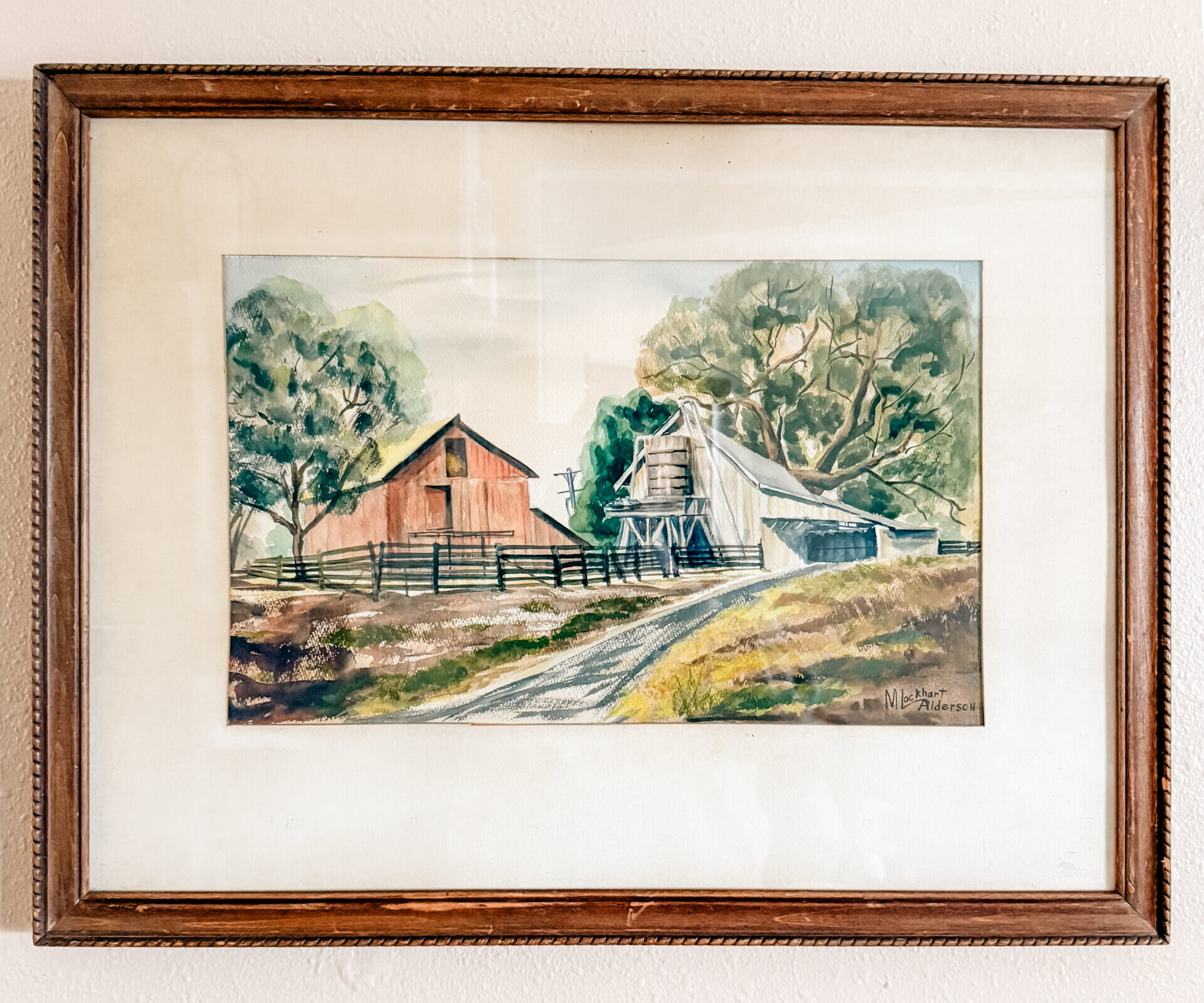
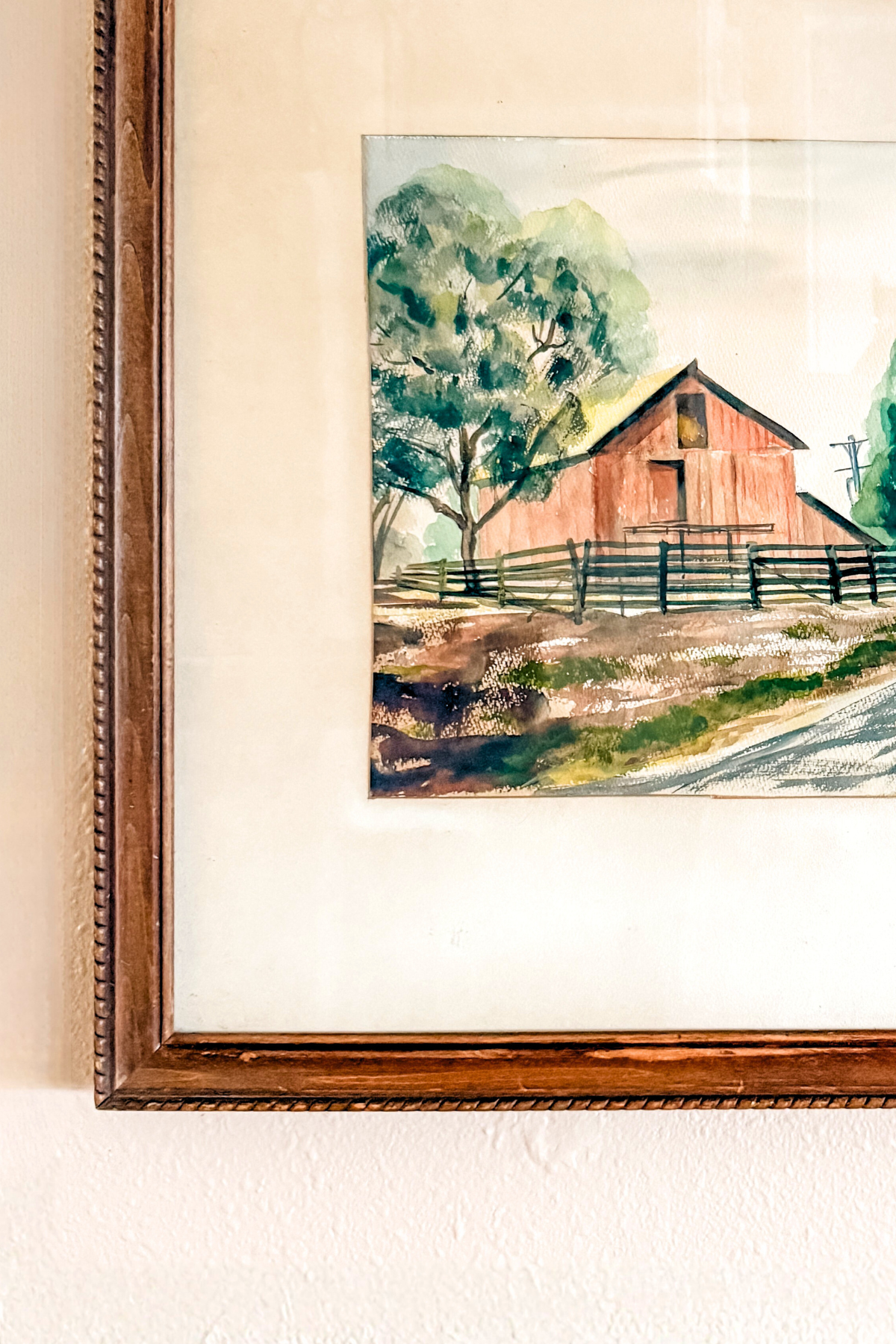
It’s presumably a plein air piece, meaning Milli (Mildred Lockhart Alderson) positioned herself in front of this lovely scene sometime in the 1950s and sketched it out on her canvas. Oh, the thought of it gave me goosebumps! Standing in that quiet driveway in the warmth of the sun, the breeze rustling through the grass… But then my fiancé walked by and pointed at the power pole poking out from behind the tree. I’d seen it myself, of course, it just hadn’t stuck out to me because I wasn’t critiquing the painting, I was enjoying it.
Not as if I can paint like this at all, but once he said it, I couldn’t help but acknowledge that I surely would’ve left the pole out. It’d be more timeless without it, right? Also, it’s leaning. Ugh, no fixing watercolor. And the fence line is askew, too. Boy, what a frustrating mistake that must’ve been. Horizon lines are an objective standard, after all! And why is there still white showing in the driveway anyway? I’m sure I would’ve filled it in…
In fact, presuming I ever got as far as this beautiful finished pie– Ah, and here came the epiphany: I wouldn’t have called this finished. This painting that I saw as flawless until I began to apply the same warped “objective” standards of good and of doneness that I hopelessly apply to my own work, it would’ve hardly been acknowledged even as an iteration if it were my responsibility to declare it done. I would’ve been busy flooding the paper trying to perfect everything until it was absolutely overdone.
Why?
As I’ve begun to think more deeply about the things I enjoy, I’ve realized a common thread. Who I like, what I listen to, what I display — it is all quite objectively imperfect. Maybe most art is. But, specifically, I’m heavily drawn to things that I’d never scrutinize as “done” if they were in my hands. Perhaps it’s a form of permission seeking; it’s somehow thrilling, reassuring even, to see proof of others declaring their “imperfect” works, any which way askew, as not only worth keeping but worth something. Worth framing. Worth putting out into the world.
This painting was first sold to a Mrs. Howard Jones in 1965, later to any number of people whom I’m certain enjoyed it thoroughly, and finally to me. Only because Milli had the self-assuredness to see value in her work, and was partial to her own truth over whatever objectivity could be applied.
I realize restraint is learned. But is it learned by over-doing? Is it learned by under-doing? Is it a matter of getting comfortable with any iteration you spin out? How do you step back and know when you’ve reached a point where an iteration is perfect — no matter how objectively imperfect it is?
As I’m slowly learning, declaring something “done” is only a matter of belief. A belief an artist must learn to embrace with conviction. Thinking beyond the external guideposts I’m always desperate to define, I’m attempting to feel out an emotional truth this year. My emotional truth. And learning to trust it without anyone external validation so that more of my work can make it off my desk and into the world where it at least has the opportunity to be evocative.